
What’s included in a professional air conditioner clean?
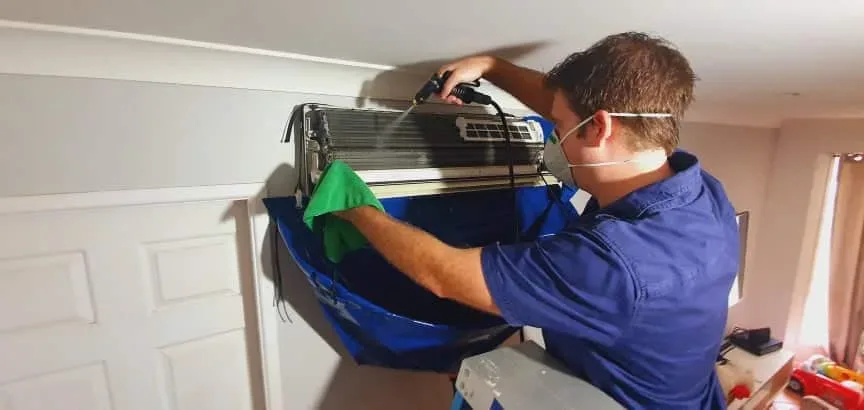
“Air conditioner cleaning” gets used to describe everything from a filter rinse to a full strip-down, which is why quotes vary so widely. This is what a professional clean should involve, step by step, so you know what you’re paying for and can hold any quote against it.
The short version
A proper clean means the unit is opened up. The filters come out, the coil and blower wheel are cleaned directly, the drain pan and line are flushed, and everything is dried, refitted and tested before we leave. If none of that happens, what you’ve had is a wipe down.
A single split usually takes 45 to 60 minutes. Here’s where that time goes.
Start to finish
1. Inspection and checks before anything comes apart
We run the system and note how it’s behaving: airflow at the outlet, the temperature it’s achieving, any noise from the fan, whether the drain is clearing. This matters for two reasons. It tells us where the contamination is, and it establishes what was already wrong before we touched it. If a system has a fault that cleaning won’t fix, this is when we find it and tell you.
2. Isolating power and protecting the room
Power is isolated at the isolator or breaker, not just switched off at the remote. Furniture and flooring below the unit are covered, and a purpose-made catch bag is fitted around the indoor unit so the run-off from cleaning drains into a bucket rather than down the wall. This is the step that separates a controlled job from a mess.
3. Filters out and washed
Filters are removed, washed, and inspected for damage or distortion. If a filter is torn or has lost its shape, it stops sealing properly and lets dust bypass it entirely, so we’ll tell you if one needs replacing rather than refitting it.
4. Front cover and louvre assembly removed
The casing comes off so the coil and fan are actually accessible. On most splits this is the point where people realise how much sits behind a filter they’d been washing diligently for years.
5. Evaporator coil cleaned and treated
The coil is where condensation forms, so it’s where dust binds and growth establishes. It’s treated with an HVAC-appropriate cleaner and flushed through, working with the fin direction rather than across it so the fins aren’t bent. Bent fins restrict airflow permanently, which is one of the reasons this isn’t a job for a stiff brush.
6. Blower wheel and barrel fan cleaned
The barrel fan sits behind the coil and is the single most contaminated component in most systems we open, and the one most often left untouched when a unit isn’t opened up. Build-up packs into each blade, which reduces the air it can move and puts whatever is growing there directly into the airflow. Only a narrow strip of it is visible through the outlet, so working from the front reaches a fraction of the surface at best and no spray will clear packed material. Cleaning the whole circumference properly needs the unit dismantled. This is the part of the job that makes the difference you can smell.
7. Drain pan and drain line flushed
The pan is cleaned out and the condensate line is flushed through and checked for flow. A partly restricted drain is the most common cause of an indoor unit dripping, and clearing it while the unit is already open costs nothing extra. Left alone, it becomes the callout described in air conditioner leaking water.
8. Casing, louvres and vent surfaces
The removed panels are washed separately, including the louvre blades where visible growth usually appears first. On ducted systems this extends to the return air grille and each supply register.
9. Sanitising treatment
Once surfaces are physically clean, an HVAC-safe treatment is applied to the coil and internal surfaces. The order matters: applying a treatment over existing build-up achieves very little, because it never reaches the surface underneath.
10. Reassembly, testing and handover
Everything is dried before it goes back together, because refitting damp components defeats the purpose. The system is reassembled, power restored, and run to confirm airflow, drainage and temperature. We tidy up, walk you through what we found, and tell you plainly if anything needs attention that isn’t hygiene related.
How it differs by system type
What sits outside a hygiene clean
Our work covers the full internal clean and the condensate drainage system. A few things sit outside that scope, and it’s worth knowing what they are so you can compare quotes properly.
Our inspection identifies these before we begin, so if one of them turns out to be the real problem you’ll know up front rather than paying for a clean that wouldn’t have fixed it. Before booking anyone, it’s worth reading what you need to know before you book, which covers which components can and can’t be reached. Distinguishing a hygiene issue from a mechanical one is covered in why is my air conditioner not cooling.
This is the job, at a fixed price
Every clean follows the sequence above. You get the price before we start and photos of what we found when we finish.
What you should get afterwards
Before and after photos of the components that were cleaned, a note of anything we found that needs watching, and a recommended date for the next service based on how this one looked. For property managers and body corporate work we provide this as a written record per unit, which is usually what’s needed for owner reporting.
Common questions
How long does a professional clean take?
Around 45 to 60 minutes for a single split system, and up to 90 for one that hasn’t been cleaned in many years. Cassettes and ducted systems take longer again. We’ll give you a realistic window when we book.
Do you need access to water and power?
Yes to both, and access to the isolator or switchboard so power can be isolated properly. A tap and somewhere to empty a bucket is all that’s needed on the water side.
Will there be water or mess in the room?
There’s water involved, which is exactly why the catch bag and floor protection go up first. Done properly, the room is left as we found it. If anyone quotes you a clean that involves no containment, ask where they think the run-off goes.
Do you clean the outdoor unit as well?
We clear the outdoor coil and its surrounds as part of the job, since a blocked condenser affects the whole system’s performance. It’s a simpler job than the indoor unit because there’s no condensation and no occupied room to protect.
Do I need to be home?
Someone needs to provide access, but you don’t need to stay in the room. For tenanted and managed properties we coordinate access directly with the manager and report back with photos.
Spotless Clean Air Services holds a Certificate II in Air Conditioning Hygiene accreditation. The sequence described here is the process we follow on every job.