
Why cleaning your air conditioner filter isn’t enough
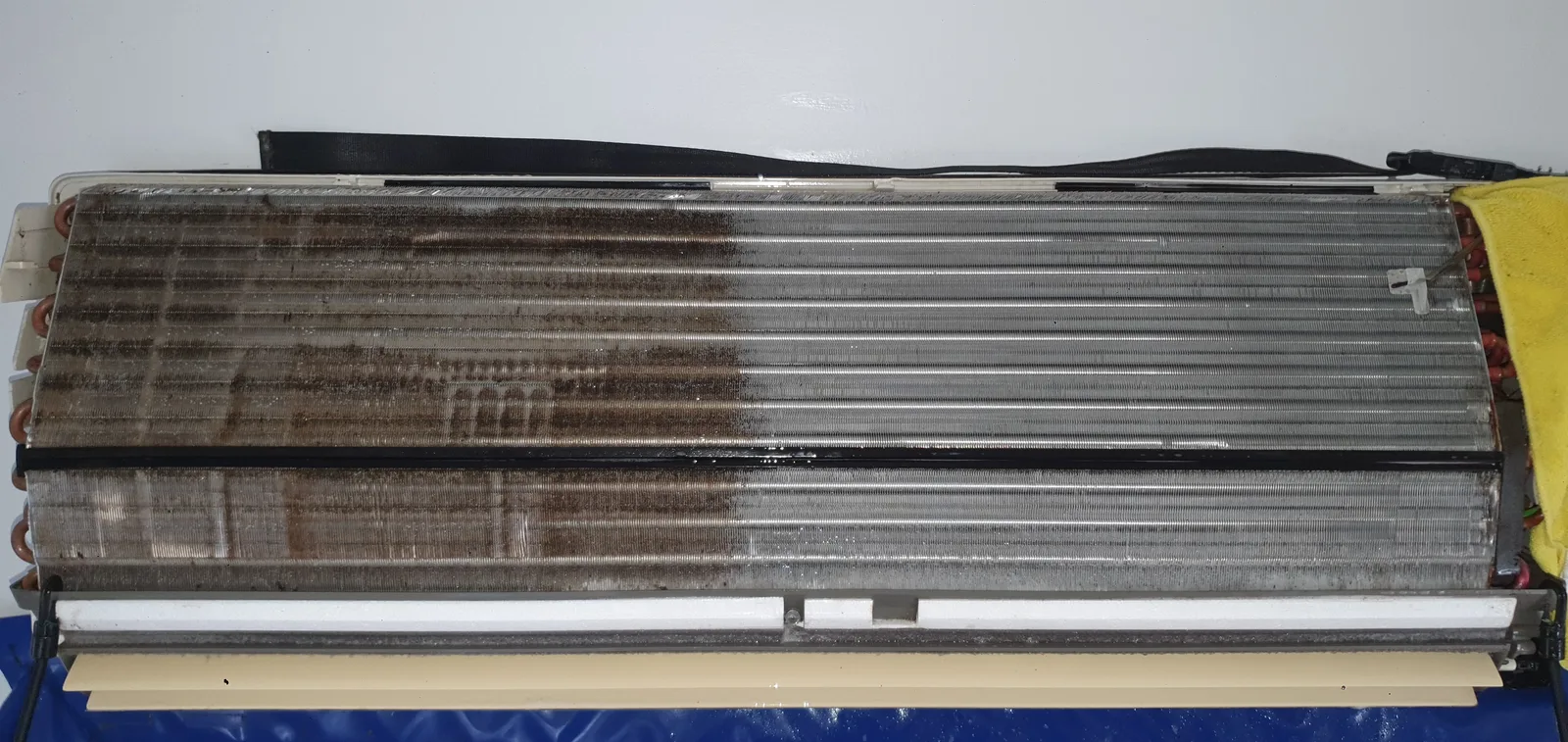
If you wash your filters every few weeks, you’re doing more maintenance than most people. It’s genuinely worth doing. But it protects only the first few millimetres of a system that’s considerably deeper than that, and it explains why a diligently maintained unit can still smell musty. Here’s what sits behind the filter, and why it needs its own attention.
What the filter is actually designed to do
The mesh filter in a domestic split system exists to protect the coil, not to purify your air. It catches lint, hair and larger dust so those things don’t pack into the coil fins and choke airflow. That’s a real job and it does it reasonably well.
What it isn’t is a fine filter. The mesh in a standard split is coarse, because a fine filter would restrict airflow more than the fan can handle. Fine particles pass straight through by design.
What gets past it, and why that matters
Fine dust, cooking oil vapour, skin cells, pollen and mould spores all pass through a coarse mesh. On their own, passing through wouldn’t matter much. The problem is what they land on.
Immediately behind the filter is the evaporator coil, which is wet whenever the system is cooling. Fine dust hitting a wet surface doesn’t blow off again. It sticks, layers up, and provides both the material and the moisture that mould needs. Cooking oils make it worse, because they leave a tacky film that everything else adheres to.
Where the filter’s protection ends
Three components sit behind the filter and hold the contamination that actually causes problems: the evaporator coil, the blower fan behind it, and the drain pan underneath. All three are wet whenever the system cools, all three collect the fine material the filter lets through, and none of them are affected by how well you wash your filters.
The blower fan is usually the worst of the three. It sits behind the coil, so material packs into the blades over years, reducing the air it can move and sitting directly in the airflow going into your room. Only a narrow strip of it is visible through the outlet, and the back of the coil and the drain pan can’t be seen at all. The drain pan matters for a different reason: as biofilm narrows the line, water stops clearing and eventually overflows, which is covered in air conditioner leaking water. For the full walkthrough of each component and why access decides everything, see what you need to know before you book.
Why the smell returns days after you wash the filters
This is the question that brings most people to us, and the answer is simple once you know the layout. Washing the filter removes the dust you can see and briefly improves airflow, which can make the smell seem better for a day or two. But the growth producing the odour is on the coil, the fan and in the drain pan, none of which were touched.
As soon as the system runs and those surfaces get damp again, any odour tied to them returns. It isn’t that you cleaned the filter badly. It’s that the filter was never the source. Our guide to what different air conditioner smells mean works through the causes by smell type.
How to tell the problem is behind the filter
Shine a torch into the outlet with the system off and look at the fan blades. If you can see build-up packed along them, that’s your answer, and it’s a full split system clean rather than anything you can reach yourself.
Filter cleaning is still worth doing properly
Whether it’s worth paying for that is a fair question, and we work through it honestly here. None of this means stop washing your filters. A loaded filter chokes airflow immediately and lets more material past as it distorts, so keeping it clean genuinely slows down how quickly everything behind it loads up. It’s the cheapest thing you can do to extend the interval between full cleans.
Two details worth getting right: dry them completely before refitting, because a damp filter going back into a unit adds moisture exactly where you don’t want it, and replace any filter that’s torn or has lost its shape, since a filter that no longer seals lets dust bypass it entirely. The method is in how to clean a split system air conditioner.
Filters clean, still smells?
Then it’s the coil, the fan or the drain. We open the unit up and clean all three. Fixed price, quoted before we start.
The right split of the work
Filters washed and dried fully. Louvre faces and casing wiped. Outdoor unit kept clear. Fan or dry mode run before shutdown so the coil dries out.
Casing off, coil treated, barrel fan cleaned, drain pan and line flushed, everything dried and tested. See what’s included in a professional clean and intervals in how often should you clean your air conditioner.
Common questions
Is washing the filter enough maintenance?
It’s enough to keep airflow reasonable and slow down build-up behind it. It isn’t enough to keep the coil, the barrel fan or the drain line clean, because a filter has no effect on any of those.
Why does my unit still smell after I clean the filters?
Because the smell is coming from growth on the coil, the fan blades or in the drain pan, all of which sit behind the filter. Washing the filter doesn’t reach any of them, so the odour returns as soon as those surfaces get damp again.
Would a better filter fix it?
A finer filter catches more, but it also restricts airflow, and most domestic splits aren’t designed for one. Fitting a filter the fan can’t pull air through creates a different problem. It also does nothing about contamination already inside the unit.
How often should filters be washed?
Every two to four weeks while the system is in regular use. If they look loaded within a week, the environment is unusually dusty and the full clean should be brought forward too.
Do washable filters need replacing eventually?
Yes. Repeated washing eventually stretches or tears the mesh, and a filter that no longer sits flat in its channel lets air bypass it around the edges. We check filter condition on every service and tell you if one is past it.
Spotless Clean Air Services holds a Certificate II in Air Conditioning Hygiene accreditation. The components described here are the ones he opens up and cleans on every job.