
Air conditioner cleaning: what you need to know before you book
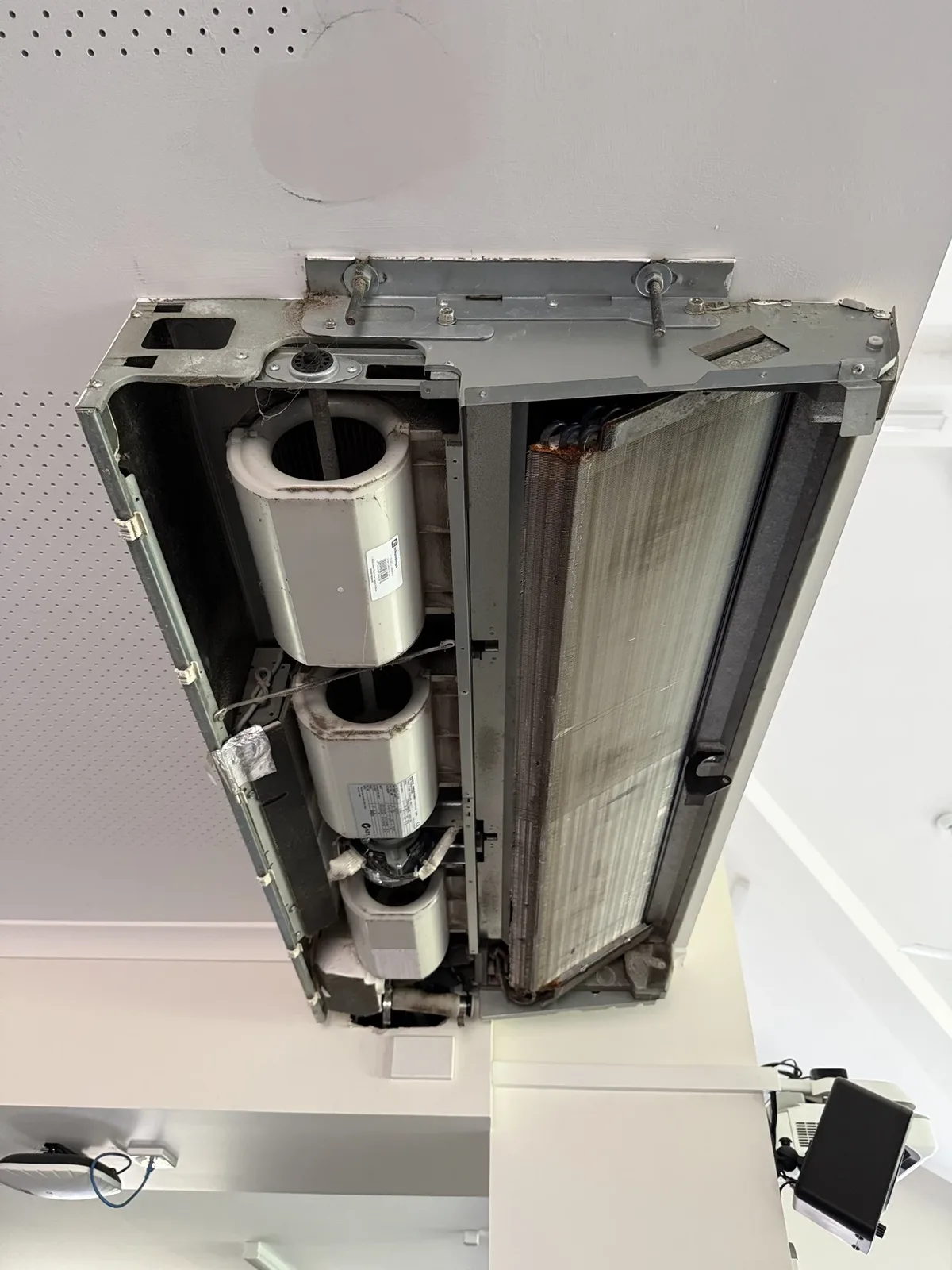
If you’re paying someone to clean your air conditioner, the fair question is: what am I actually getting? It’s harder to answer than it should be, because “air conditioner cleaning” describes two quite different jobs. One is a surface service: filters washed, front panel wiped, a treatment sprayed through the outlet. The other involves removing the casing so the coil, the blower fan and the drain pan can be cleaned directly.
Only one of those is a clean. The casing has to come off, because the components that hold contamination sit behind it, and no amount of skill or product reaches them otherwise. This article explains what’s inside your indoor unit, why access is the deciding factor, and what to ask before you book, so you know what you’re comparing when two quotes differ.
First, what’s actually inside the indoor unit
A wall-mounted split has four components that matter for hygiene, arranged front to back in the direction the air travels. What’s included in a professional clean covers how each one is handled on the day.
Directly behind the front panel. Designed to catch lint and larger dust so it doesn’t pack into the coil. Removable by hand, no tools required.
A dense pack of thin aluminium fins immediately behind the filters. This is the surface that gets cold, so condensation forms on it whenever the system cools. You can see its front face once the filters are out. The depth of the fin pack is where material accumulates.
A long cylindrical fan sitting behind the coil, running the width of the unit. It draws air through the coil and pushes it into the room. Because it sits downstream of a wet surface, damp material packs into the individual blades. A narrow strip of it is visible through the outlet, so it can be partially reached, but only the strip facing the aperture at any one time.
Beneath the coil. Collects the water condensing off it and drains outside through a narrow pipe. Fine material washes down here and, over time, forms a biofilm that narrows the line.
The arrangement matters. The filter is first in line, so it is the least contaminated part of the system. The blower fan and drain pan sit behind and below it, and they are typically the most contaminated. That is the opposite of what most people assume from looking at a dirty filter.
What the casing physically prevents access to
With the front panel open and the filters out, you can reach the filters themselves, the inner face of the panel, the louvre blades and the front face of the coil. That is the extent of it. Everything else is enclosed.
The blower fan is a partial exception worth being precise about. The outlet aperture at the bottom of the unit exposes a narrow strip of it, so it is possible to reach some of the blade surface from the front, and some operators do. The limitation is that you are working blind through a gap on a curved surface, so the result is uneven at best, and the material packed deepest into the blades stays where it is. It can be touched. It cannot be cleaned properly.
Reaching them is the whole point of a professional split system clean. The components that genuinely cannot be reached are the coil and the drainage. The coil has two faces, and only the front one is visible with the filters out. The back face, where air exits into the fan housing, is inaccessible entirely, as is the depth of the fin pack between them. The drain pan sits enclosed beneath the coil and can sometimes be partially seen with a torch, but not cleaned out, and the condensate line running from it cannot be flushed or flow-tested without access. Internal insulation, the casing interior and the housing behind the louvre assembly are in the same position.
If the casing stayed on, the filters and the visible surfaces were cleaned, and part of the blower fan may have been reached through the outlet. The back of the coil, the depth of the fin pack, the drain pan and the condensate line were not, because they cannot be. This is a matter of physical access, not effort or intent.
Why those specific components matter
The blower fan sits directly in the airflow path
Odour rarely comes from one component. It comes from the combination of contaminated surfaces sitting in the path of the air being delivered to the room, and the blower fan is one of the most heavily loaded of them. Air leaving the coil is cool and damp and passes straight over the blades. Dust that made it past the filter lands on those wet surfaces and stays there, compacting into the blade profile over several seasons.
Two consequences follow. The fan can no longer move the air it was designed to, so airflow drops even with clean filters. And anything growing on it is directly in the air leaving the unit. Clean the fan but leave the coil face or the drain pan contaminated and the smell persists, which is why the whole airflow path has to be addressed in one visit. We cover this in why cleaning your air conditioner filter isn’t enough.
The coil needs cleaning through its depth, not across its face
Wiping or vacuuming the front face of a coil removes surface dust. The material that restricts airflow and holds moisture sits between the fins, several millimetres in. Reaching it requires a cleaning agent applied with the coil accessible and enough water to flush the loosened material out, with somewhere for it to go.
The drain is the reason a clean holds or doesn’t
If the condensate line is partly restricted, water sits in the pan between uses rather than clearing. That standing water is a permanent damp reservoir directly beneath a coil you have just cleaned, and it will recontaminate the components above it. A blocked drain is also the leading cause of an indoor unit dripping onto a wall, which is covered in air conditioner leaking water. Flushing and flow-testing the line is not an optional extra, it is what makes the rest of the work last.
Why containment tells you a great deal
Cleaning a coil and fan properly involves water, and that water has to be collected. The standard method is a purpose-made catch bag fitted around the indoor unit, funnelling run-off into a bucket. Floor and furniture below are covered first.
This is a useful thing for a customer to look for, because it works in both directions. If containment was set up, water was used, and water means the internal components were actually washed. If no containment was used, either no water was used, or it went somewhere it shouldn’t have.
There is also a practical reason it matters beyond verification: uncontained run-off from an indoor unit goes down the wall or into the cavity behind it.
A note on aerosol coil cleaners
Foaming coil cleaners work on a specific principle: the foam expands into the coil, lifts material, then breaks down and drains out through the condensate line. That works when the coil is properly accessible and the drain is clear.
Two limitations matter. First, they depend entirely on the drain being clear. In a unit contaminated enough to need cleaning, the drain is frequently already restricted, so the residue and the material it loosened collect in the pan rather than leaving the system. Second, they do not reach the blower fan, which sits outside the spray path and is usually the more contaminated component. Used as part of a full clean with the casing off and containment fitted, they work as intended. Used through the outlet of an assembled unit, they cannot.
A treatment applied over existing build-up also has limited effect, because it never contacts the surface underneath. Physical removal first, treatment second, is the order that works.
Realistic timeframes
Time is not a perfect measure of quality, but it is a reasonable indicator of scope, because each stage takes a predictable amount of time.
Setting up containment, removing and refitting the casing, and drying components before reassembly account for a significant share of that time. A job completed in fifteen minutes has not included those stages, which means the coil depth, the blower fan and the drain were not touched. That is a filter wash, and it should be described as one.
Know what you’re booking
Every job includes removing the casing, cleaning the coil and blower fan, and flushing the drain, with photographs of each component before and after. Fixed price quoted before we start.
Signs a clean reached the internal components
Checking the work afterwards
With the system switched off, shine a torch into the outlet at the bottom of the indoor unit and look at the fan blades. A cleaned barrel fan shows clean, defined blade edges. One that hasn’t been cleaned shows a grey or dark build-up packed along the blade profile, and the edges look thickened or blurred.
Then run the system for a few minutes and stand near it. The most common indicator that internal components were missed is a musty smell returning within days, because the material producing it is still on surfaces that were never reached. If you’re working through an odour, why does my air conditioner smell covers what each smell points to.
Finally, on a humid day, check that water discharges freely from the drain outlet outside while the system runs. If little or nothing comes out, the line is likely still restricted.
Questions worth asking before you book
The first question is the one that matters most. If the answer is anything other than a clear yes, you are buying a filter wash, whatever it is being called. These questions take a minute to ask and settle it before you commit.
Where filter washing does fit
Washing your filters every few weeks is genuinely worthwhile, and it’s something you can do yourself in twenty minutes. It restores airflow a loaded filter was choking and slows how quickly material reaches the coil behind. Our guide to cleaning a split system yourself covers it properly.
What it isn’t is a service worth paying a technician for. If you’re engaging a professional, you’re paying for access to the components you cannot reach, and that means the casing coming off. How often should you clean your air conditioner covers what interval suits which system.
What to do if you think you paid for more than you received
Start by asking the business what the job included. Ask specifically whether the casing was removed and whether the drain was flushed, since those two answers settle most of it. If the casing stayed on, the coil depth, the blower fan and the drain pan were not cleaned, and it is reasonable to say so.
If a musty smell has returned quickly, that is worth investigating regardless of who did the work. Why does air conditioner mould keep coming back works through the reasons a clean doesn’t hold, several of which have nothing to do with the technician.
Common questions
How long should a proper air conditioner clean take?
Around 45 to 60 minutes for a single split system, closer to 90 for one that has never been serviced, and longer again for cassettes and ducted systems. Setting up containment, removing and refitting the casing and drying components account for much of that.
Can the blower fan be cleaned without removing the casing?
Partially, and that’s the honest answer. The outlet aperture exposes a strip of the fan, so some of the blade surface can be reached from the front. What you can’t do is see what you’re doing, reach the whole circumference evenly, or clear material packed deep into the blades. The back of the coil and the drain pan can’t be reached at all.
Is a spray-only clean worth anything at all?
It has real limits. It relies on the drain being clear, which in a unit that needs cleaning it often isn’t, and it does little for the blower fan, which sits outside the spray path. As part of a full clean once the casing is off it has a role. As the whole job, it leaves the most contaminated component untouched.
Why did the smell come back a fortnight after my clean?
Most often because the source was on a component that wasn’t reached, typically the blower fan or the drain pan. It can also happen where the drain is still restricted, so standing water recontaminates surfaces that were cleaned. Both are worth checking before assuming the work was poor.
Should there be dirty water at the end of the job?
On a system that needed cleaning, yes. Washing a coil and blower fan produces run-off, and that run-off is collected in a bucket via a catch bag. It’s one of the clearest indications that the internal components were actually washed rather than wiped.
Does a higher price always mean a better clean?
Not automatically, but a price well below the market usually reflects a shorter job rather than better value. The useful question is what the work includes. Ask whether the casing comes off, whether the blower fan is fully accessed rather than reached through the outlet, and whether the drain is flushed, then compare quotes on that basis. How much does air conditioner cleaning cost covers what genuinely drives the price.
Spotless Clean Air Services holds a Certificate II in Air Conditioning Hygiene accreditation. This article describes component access and job scope as they apply to standard wall-mounted split systems. It is written to help customers compare services accurately before booking, not to characterise any particular business.