
Can you remove mould from an air conditioner yourself?
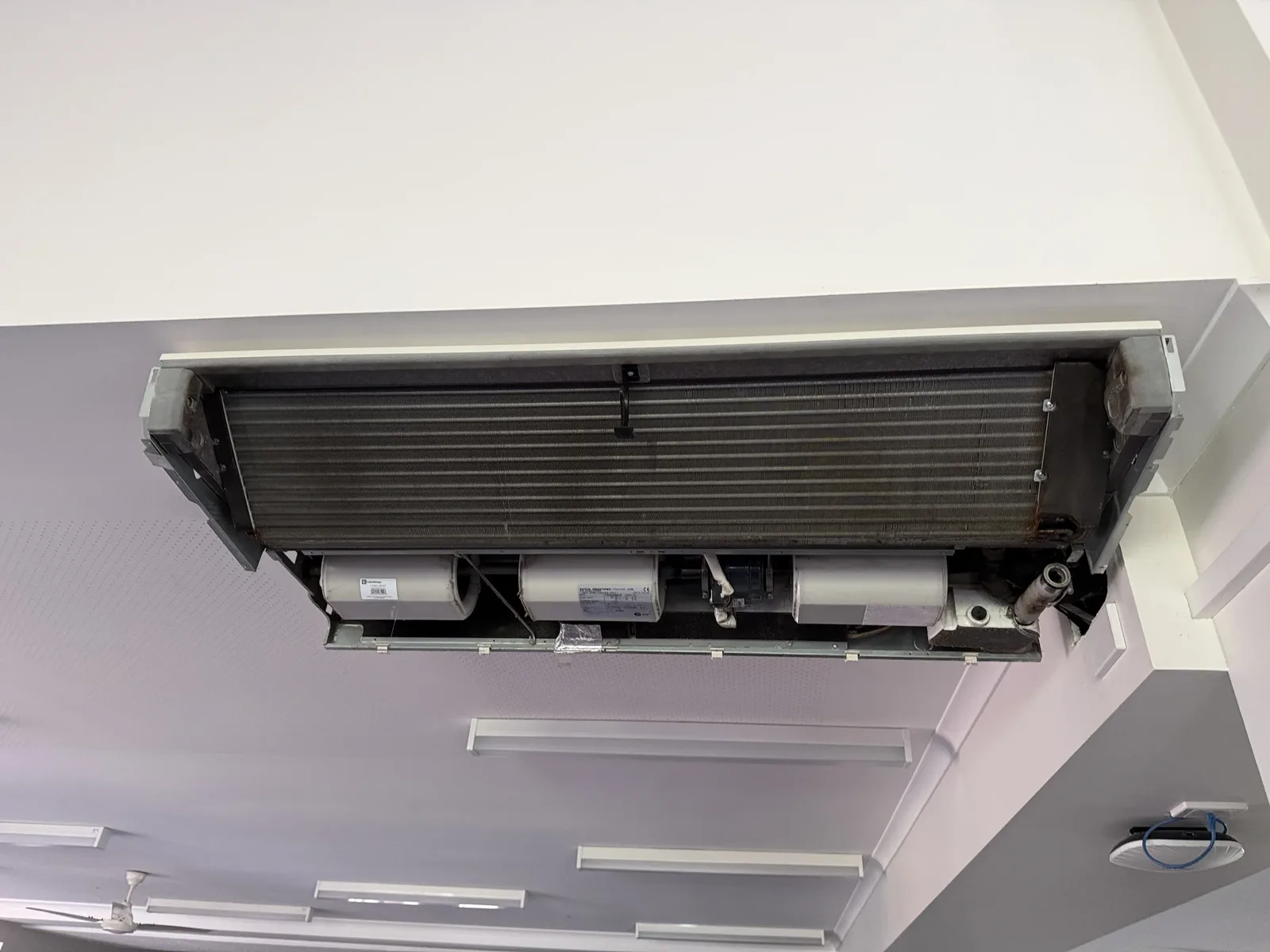
Partly, and it depends entirely on where the mould is. You can safely clean the surfaces you can see and reach. What you can’t do is get to the coil and the barrel fan, which is where most of it actually lives, and attempting it does more harm than good. Here’s the honest line.
The short answer
If you can see mould on the louvres, the filters or the outer casing, you can clean that yourself and it’s worth doing. If the unit smells musty but you can’t see anything, the growth is on the coil, the barrel fan or in the drain pan, and none of those are reachable without dismantling the unit.
That second case is the common one. Visible mould on a louvre is usually the tip of it.
What you can safely clean yourself
The filters
Remove them, brush the loose material off outside, then rinse under warm running water. If you’d rather use a product, choose a cleaning solution suitable and intended for HVAC use and follow the label directions. Work the brush from the clean side so you’re pushing material out of the mesh rather than through it. Dry completely before refitting. If a filter has visible growth embedded in the mesh that won’t wash out, replace it.
Louvres and outer casing
Wipe with a cloth dampened in warm water and wrung out well. Move the louvre blades gently by hand to reach both faces, and stop if one resists, since they’re driven by a small motor that will break if forced. Use a fresh section of cloth as you go rather than spreading it around, and dispose of the cloth or wash it separately afterwards.
Visible vent and register surfaces
On a ducted system, the return air grille and the face of each supply register can be wiped down or, if removable, washed and dried properly. Everything past that point is a ducted system clean. Inside the ductwork itself is not a DIY job.
What you shouldn’t attempt
Spraying anything into the coil
The control board sits behind the casing at one end of the indoor unit, close to the coil, and water introduced from the front has no controlled path out. Aerosol coil cleaners rely on draining through the condensate line, which in a mouldy unit is usually already partly restricted, so the residue and whatever it loosened ends up in the pan and then your wall.
The barrel fan
This is where most of the mould is, and it’s the one component you genuinely cannot get to. What’s included in a professional clean covers how it’s reached. Reaching it means removing the casing and working around live electrical connections, the drain pan and the refrigerant lines. Build-up packed into the blades doesn’t wipe off either, it needs a proper wash with the run-off contained.
Bleach and strong household chemicals
Bleach corrodes the aluminium fins and surrounding metal, and residue left inside a unit ends up in the airflow every time it runs. It also doesn’t penetrate the material mould grows in, so on a porous or built-up surface it discolours the mould without removing it. Mild soapy water and physical removal is both safer and more effective on the surfaces you can reach.
Dismantling the unit
Beyond the electrical risk, there’s no containment for the run-off, the plastic clips on older units break readily, and it may affect your warranty. Check your handbook before you consider it. The full comparison is in professional vs DIY air conditioner cleaning.
Why surface cleaning doesn’t hold
You clean the louvres, the visible mould is gone, and two weeks later it’s back. That’s because the growth on the louvres was downstream of the source. Why mould keeps coming back works through the other reasons it recurs. Spores and material are still on the coil and fan, still landing on the louvres every time the system runs, still meeting the same condensation.
Surface cleaning is worth doing, it just isn’t a fix. See why does air conditioner mould keep coming back.
Sensible precautions if you do clean it
That last point matters. Dry brushing or blowing at a heavily affected surface releases far more into the room air than leaving it alone until someone can clean it properly with containment.
Signs it’s beyond a surface clean
Cleaned what you can and it still smells?
Then it’s on the coil or the fan. We open the unit up, contain the run-off and clean both, then flush the drain. Fixed price before we start.
What a professional clean does differently
Three things you can’t replicate: access, containment and the drain. The casing comes off so the coil and fan are cleaned directly. A catch bag routes all the run-off into a bucket rather than into the wall or the room. And the condensate line is flushed and confirmed flowing, so water isn’t sitting in the pan feeding the next round of growth.
The full sequence is in what’s included in a professional air conditioner clean. For a split system that’s from $140, and the split system cleaning page has the detail.
If someone in the home is sensitive to mould
Our expertise is in removing this material safely rather than advising on health effects. If someone in your household reacts when the system runs, or has a diagnosed respiratory condition or immune sensitivity, speak to your GP about the health side and have the cleaning done professionally, so the material is contained and removed rather than disturbed.
Queensland Health publishes general guidance on mould in the home if you want to read further on the health side. We service medical and allied health clinics where hygiene standards are formalised, and the same care applies in a home where someone is sensitive.
Common questions
Can I use bleach to kill mould in my air conditioner?
We’d advise against it. Bleach corrodes aluminium fins and surrounding metal, leaves residue that ends up in the airflow, and on built-up surfaces it tends to discolour mould rather than remove it. Physical removal with mild soapy water is safer and more effective on reachable surfaces.
Does vinegar remove air conditioner mould?
It’s popular advice, but it’s acidic and not ideal on aluminium and internal metal components, and it leaves a smell of its own. It also doesn’t solve the access problem, which is the real issue. Mild soapy water does the job on surfaces you can reach.
Are mould-killing aerosol sprays safe to use inside a unit?
They depend on the condensate drain to carry the residue away, and in a unit with mould the drain is often already restricted. They also don’t reach the barrel fan, which is usually the main source. We wouldn’t recommend using one blind.
Should I wear a mask when cleaning mould?
Yes, a fitted P2 mask and disposable gloves, with the room ventilated. Wipe rather than brush or blow, so you’re not putting material into the air. If the growth is heavy, don’t disturb it at all.
When should I stop and call someone?
When the smell persists after cleaning everything you can reach, when you can see build-up on the fan blades, when growth returns within weeks, or when it would mean removing the casing. That’s the line.
Should I keep using the system while it has mould in it?
That’s a personal call, and if anyone in the home is reacting to it, it’s worth discussing with your GP rather than us. Practically, running it in fan mode won’t help the situation and running it in cooling keeps the surfaces damp. Getting it cleaned is the thing that resolves it.
This article is general information, not advice for your specific system. Every make and model differs, so check your manufacturer’s handbook before carrying out any maintenance yourself. If you are not confident at any point, stop and have the work done professionally. Spotless Clean Air Services accepts no responsibility for damage or injury arising from work carried out by the reader.
Spotless Clean Air Services holds a Certificate II in Air Conditioning Hygiene accreditation. This article deliberately makes no claims about health effects, which are a matter for your GP and Queensland Health rather than a cleaning business.