
Why does mould grow inside air conditioners?
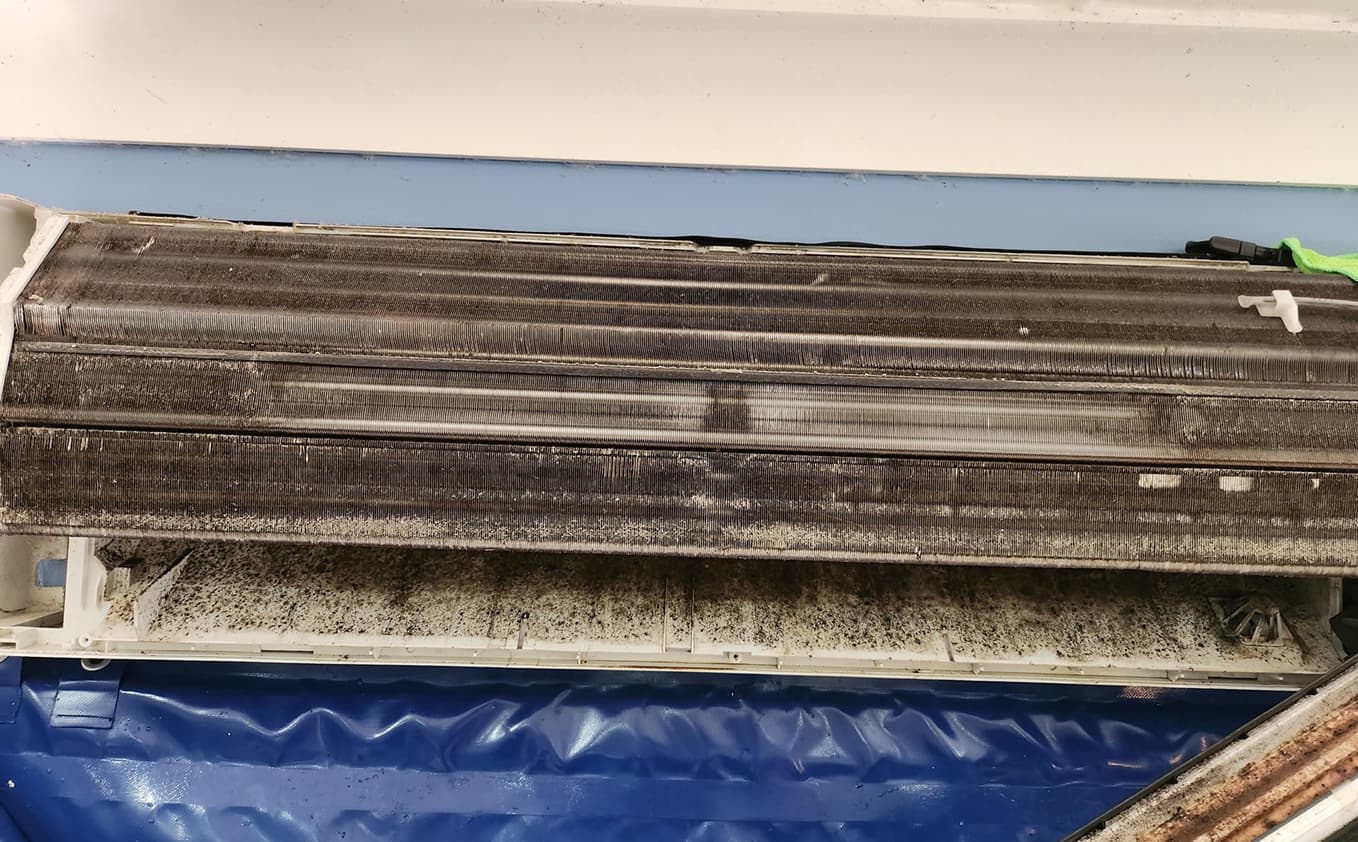
Mould needs three things: moisture, something organic to feed on, and a dark still place to sit. An air conditioner supplies all three every time it runs. That’s not a fault in your system, it’s how cooling works, and it’s why we find growth so consistently in units that haven’t been cleaned.
The three things mould needs, and why your unit has all of them
Moisture: condensation on the coil
An air conditioner cools by passing warm room air across a coil colder than the air’s dew point. Moisture condenses out onto that coil, exactly as it does on a cold drink. That water runs down into a pan below and drains outside.
So the inside of the unit is wet whenever it’s cooling, and stays wet for hours afterwards if you switch it straight off. That’s the single biggest factor.
Food: dust and organic matter
Mould doesn’t feed on metal or plastic, it feeds on what settles on them. Fine dust, skin cells, pet dander, pollen and cooking oil vapour all pass through a standard filter, which is coarse by design. On a dry surface that material would blow off again. On a wet coil it sticks and layers up.
Conditions: dark, enclosed and still
No light, minimal air movement when the system is off, moderate temperatures. If you designed an incubator you’d struggle to do better. This is why growth establishes quickly once the first two conditions are present.
Why humid climates make it harder
Humidity is the difference. In a dry climate a coil dries out fairly quickly after the system stops. In a humid one, particularly through a wet season, the air itself is carrying so much moisture that surfaces stay damp far longer, and more condensation forms per hour of running in the first place.
Add long cooling seasons and systems running overnight, and a unit in a subtropical climate accumulates far more wet-hours per year than the same unit would somewhere dry. Coastal properties also deal with salt air, which accelerates corrosion on the coil and gives contamination more to key into. It’s the main reason systems we clean around Noosa and the Sunshine Coast tend to load up faster than those further inland.
Where mould hides inside an air conditioner
Almost never where you can see it. By the time growth is visible on a louvre, it’s usually well established on components behind the casing.
Between the evaporator coil fins
The coil is a dense pack of thin aluminium fins, and the gaps between them are where condensation and trapped dust meet. You can see the front face of the coil once the filters are out, but the growth is in the depth of the pack, not on the surface.
The blower wheel, or barrel fan
The most contaminated component in most systems we open, and the least accessible. It sits behind the coil, spinning constantly in air that has just passed over a wet surface, so damp material packs into every blade. It’s also directly in the airflow path, which is why growth here is what you smell in the room. A strip of it is visible through the outlet, so part of the surface can be reached from the front, but cleaning it evenly and reaching material packed deep into the blades needs the casing off.
The drain pan and condensate line
Water collects here by design. If the drain flows properly the pan empties between uses. If it’s restricted, standing water sits under the coil permanently, and biofilm builds along the inside of the line. A sour or vinegary smell usually points here rather than at the coil.
Behind and along the louvres
The outlet louvres sit in the path of cool damp air leaving the unit, so they’re the first place growth becomes visible. You can wipe the faces you can reach. The surfaces behind them, and the casing interior around them, need the assembly removed.
Ducts, plenums and vent registers
On ducted systems the same conditions extend beyond the indoor unit. Flexible ducting runs through hot roof spaces, and where insulation is damaged or a joint isn’t sealed, condensation can form inside the duct itself. Register faces are the visible end of a much longer path. See ducted system cleaning.
Internal insulation and casing
Many units have foam or fibrous lining inside the cabinet. It’s porous, it holds moisture, and once growth is established in it, cleaning is harder because there’s no hard surface to work against. In bad cases the affected material needs replacing rather than cleaning, and we’ll tell you honestly if that’s what we find.
How to tell whether you have it
The honest caveat: you often can’t tell by looking. A unit with clean-looking louvres can have a heavily contaminated barrel fan six centimetres behind them. Smell is the more reliable indicator, and our guide to what different air conditioner smells mean breaks it down by odour type.
Does professional cleaning remove mould?
From the hard surfaces inside the unit, yes, and that’s the bulk of it. The casing comes off, the coil is treated and flushed, the barrel fan is cleaned blade by blade with the run-off contained, and the drain pan and line are cleared so water isn’t sitting there feeding the next round. Once those surfaces are physically clean, a treatment is applied, which is the only order in which a treatment does anything useful.
Where it gets more nuanced is porous material. Growth established in foam insulation or a damaged duct lining can’t always be fully removed by cleaning, because there’s no solid surface to clean back to. In those cases the affected material needs replacing, and we’d rather tell you that than take payment for a clean that won’t hold.
The full sequence is in what’s included in a professional air conditioner clean.
What nobody can honestly promise
That it will never come back. Mould spores are present in normal air everywhere, indoors and out, so the goal isn’t sterilisation, it’s removing the accumulated material and stopping the conditions that let it establish. A cleaned system in a humid climate that’s switched straight off wet will eventually grow something again.
Be sceptical of anyone offering permanent elimination, a guaranteed sterile system, or specific health outcomes. What a good clean delivers is a system that’s genuinely clean and stays that way for the normal service interval.
Think there’s mould in yours?
We open the unit up, clean the coil, fan and drain, and show you photos of what came out. Fixed price before we start.
A note on health
Our expertise is in what accumulates inside these systems and how to remove it properly, so that’s what we’ll describe rather than making claims about health outcomes. If someone in your household reacts when the system runs, or has a diagnosed respiratory condition, that’s a conversation for your GP, and Queensland Health publishes general guidance on mould in the home. What we can say is that having the inside of the unit professionally cleaned is a straightforward and inexpensive thing to rule out.
Keeping it from taking hold again
Run fan or dry mode for fifteen to thirty minutes before shutting down so the coil dries rather than sitting wet. Wash filters every two to four weeks in season. Keep the drain clear. Don’t set the thermostat colder than you need. Full detail in how to prevent mould in your air conditioner, and if it’s already returned after a clean, why does air conditioner mould keep coming back covers what was likely missed.
Common questions
Is mould in an air conditioner common?
In a humid climate, in a system that’s been running for a few years without being opened up, it’s the norm rather than the exception. It isn’t a sign you’ve done something wrong, it’s a consequence of how cooling works combined with not having had the inside cleaned.
Can I see mould inside my air conditioner?
Sometimes on the louvres, and occasionally on the fan blades with a torch. Most of it sits on the coil depth and the barrel fan, behind the casing. Clean-looking louvres don’t mean a clean unit.
Does mould grow in ducted systems too?
Yes, and the conditions extend further. The indoor fan coil unit works the same way as a split, and ductwork running through hot roof spaces can develop condensation where insulation is damaged. Register faces are the visible end of a much longer path.
Does running the system spread it through the house?
The barrel fan sits directly in the airflow, so material on it is in the air being pushed into the room. That’s the mechanism behind the smell. What that means for your health is a question for your GP rather than us.
Does cleaning remove it permanently?
It removes the accumulated growth. It doesn’t make the system immune, because spores are in normal air and condensation still forms every time it cools. A proper clean plus good drying habits keeps it clear for the normal six to twelve month interval.
Is a new system safe from it?
For a while, yes, because there’s no accumulated dust for growth to feed on. The conditions are identical from day one though, so a new unit run hard through a humid summer and switched straight off will start heading the same way. Good habits from the start make a real difference.
Spotless Clean Air Services holds a Certificate II in Air Conditioning Hygiene accreditation. This article makes no health claims, which are a matter for your GP and Queensland Health rather than a cleaning business.